Free
$0
- 1,500 generated words per day
- Stories up to 1,500 words
- 1 active storybook
- Personalized vocabulary review
Not just matched to A2 or B1. Matched to your vocabulary.
For learners with at least an advanced-beginner (A2) level of Spanish.
 ReadPlusOne
 Tap a word to mark it unknown · Hold for sound and meaning
Sofía llega al mercado cuando el sol todavía brilla. Quiere comprar frutas para hacer una ensalada fresca.
Saluda al vendedor, Don Pedro, que siempre tiene una sonrisa. Él le recomienda mangos dulces y jugosos.
Sofía mira los colores brillantes de las frutas. Nota un pequeño detalle: el aroma de las fresas frescas que llena la junto a la entrada.
Try a complete story
These fixed A2 and B1 samples include vocabulary notes and comprehension questions. Stories inside the app go further by adapting to you.
Stories use the words you already know, so reading feels easy and enjoyable.
A few new words appear naturally, with helpful clues right in the story.
Words you mark unknown return in later stories after increasingly longer gaps.
Answer a few meaning-in-context questions, then tell us which verb tenses you recognize. Each answer adjusts the next question and builds your starting vocabulary.
Your story uses mostly familiar vocabulary with a small number of words ready to learn. Tap anything you don't know and keep reading.
El tren llega al andén justo a tiempo. Marta busca su asiento junto a la ventana y deja la maleta en el estante de arriba. Afuera, la ciudad empieza a moverse despacio.
Words you mark unknown return sooner. Words you understand move farther apart. Future stories quietly carry the review forward.
Your new words will come back in upcoming stories.
The research
Flashcard apps drill words on their own. That's why a word you can recite from a card still stops you cold in a real sentence. You learned the card, not the word.
A 2025 study tested the other way round: take the words you're due to review and write them into a short story instead. Readers were then asked whether the story actually showed them what its new words meant. Stories built this way scored more than three times higher than the standard approach. It was the biggest difference the study found.
Kamzela, Lango & Dušek, "SRS-Stories: Vocabulary-constrained multilingual story generation for language learning," EMNLP 2025 (Industry Track). Word-usage rating 3.88 vs 1.24 out of 5, evaluated in English, Chinese and Polish.
The same paragraph, as the app sees it
Twenty-nine words. Twenty-six you already know, and they're what makes the other three readable.
Marta camina despacio por la acera. El aire de la mañana huele a pan recién horneado. Se detiene frente a una pequeña tienda y lee el cartel con curiosidad.
The Goldilocks zone
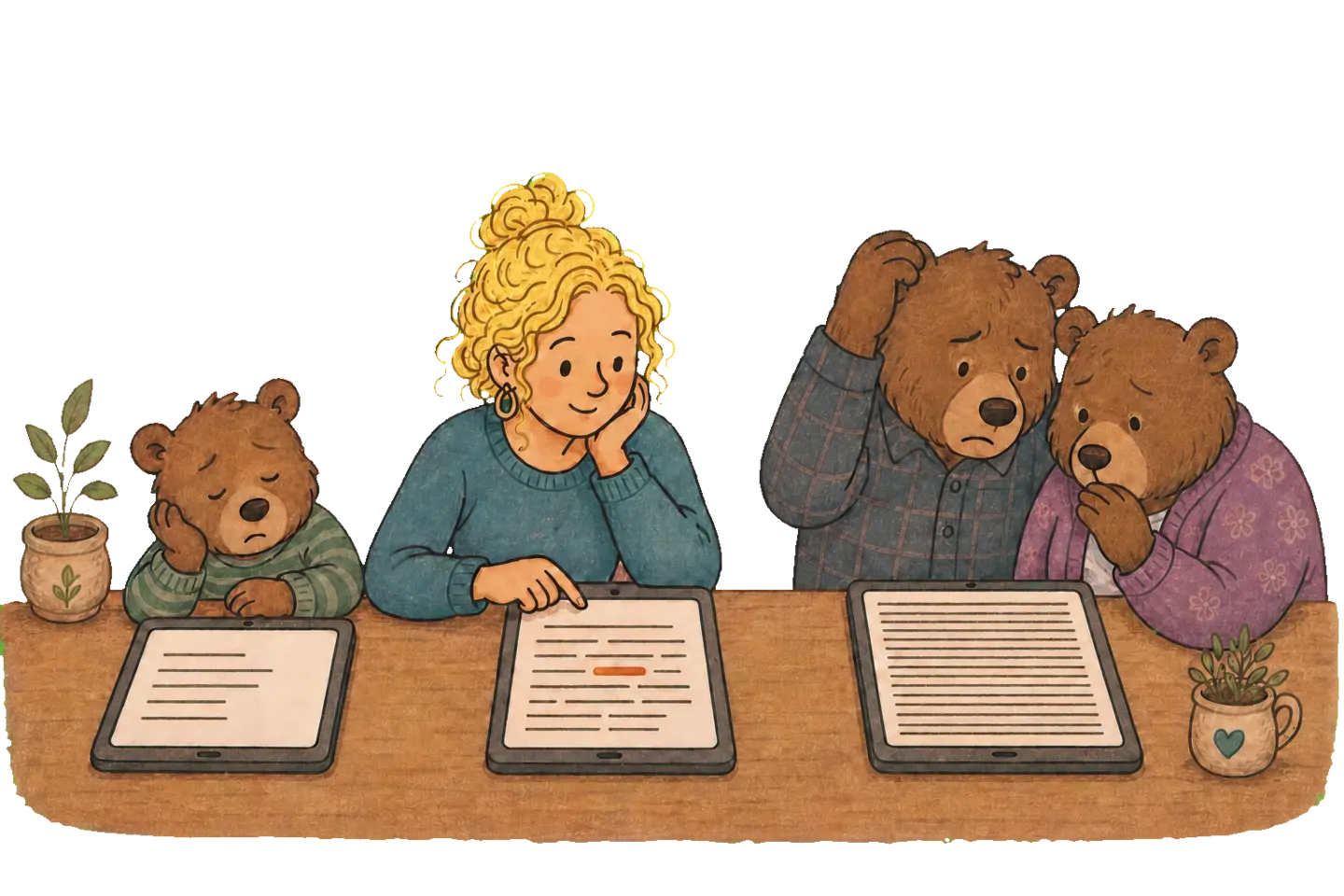
Every reader has a band where a story is comfortable and still teaching. ReadPlusOne writes into yours. Learn more about comprehensible input in Spanish.
El perro es grande. El gato es pequeño. Los dos son amigos y juegan en el jardín todos los días.
Sofía mira los colores brillantes de las frutas y nota el aroma que llena la cesta junto a la entrada.
El ayuntamiento anunció una reforma urbanística que abarca la remodelación del alcantarillado y la reubicación de comercios.
Tap a word you don't know and it joins your review schedule. Every time it comes due, it's already waiting inside whatever you read next, never on a card of its own.
“El tren salía de madrugada, cuando la estación aún estaba vacía.”
“Se despertó de madrugada y no pudo volver a dormir.”
“En la madrugada del sábado, la ciudad quedó en silencio.”
“Los pescadores salen al mar de madrugada, antes del amanecer.”
“La panadería enciende los hornos de madrugada.”
“Llegó a casa de madrugada, con los zapatos llenos de barro.”
“La niebla de la madrugada cubría todo el valle.”
Pricing
Both plans include stories matched to your vocabulary and the same spaced-review system.
Free
$0
Premium
$9 / month
We recommend you know Spanish to at least an A2 level: the basics of grammar and a working vocabulary. ReadPlusOne is built for the gap between graded readers and real books, so complete beginners will find even the easiest stories tough going.
A short quiz sets your starting vocabulary, and every word you tap or read past updates it from there.
Every draft is checked against your vocabulary before it reaches you, and rejected if too much of it sits past your level. The system also keeps calibrating as you read: over your first stories, words you read without tapping are quietly marked as known, so a placement that came out too high or too low corrects itself quickly.
Spanish is available now. More languages are planned once the model is tuned for them.
No. ReadPlusOne runs in your browser, so you can sign up and start reading right away.
Yes, on phones and tablets. ReadPlusOne is a progressive web app, so you can install it to your iPhone or iPad Home Screen, or your Android app drawer, directly from the browser. It gets its own icon and opens full screen with no address bar. There is no App Store or Google Play download, and installing is free. On a Mac or a PC, read it in a browser tab. See the install guide for the steps on each device.
Take the short placement quiz and your first matched story is ready right after.
Start reading free